what are the 4 ingredients in carbonara?
The four true carbonara ingredients, why each one matters, and what every popular substitution actually does to the dish.
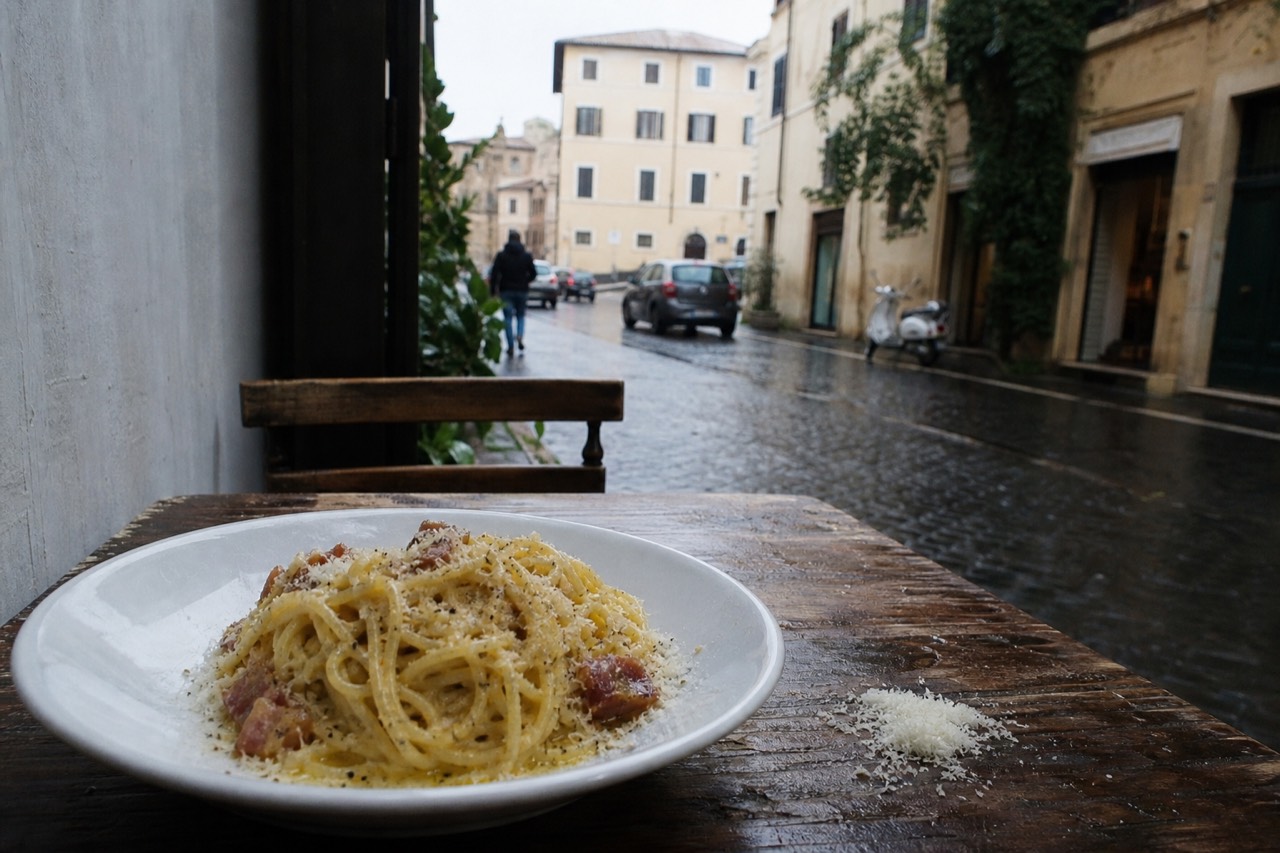
Carbonara is the most argued-about pasta dish in Italy, and the argument always comes back to the same question: what actually goes in it. An AstraRicerche survey of 1,004 Italians, released for the tenth Carbonara Day, found that 46.1% named carbonara their favorite pasta dish, ahead of every other. Yet the recipe itself is short enough to memorise in a minute, and almost every version sold outside Lazio quietly swaps one of its four ingredients for something cheaper or easier. The result is usually still tasty. It is just not carbonara as Romans understand the word. This site, Rome Food Tours, exists to document that gap between the real dish and the imitations.
what are the 4 ingredients in carbonara?
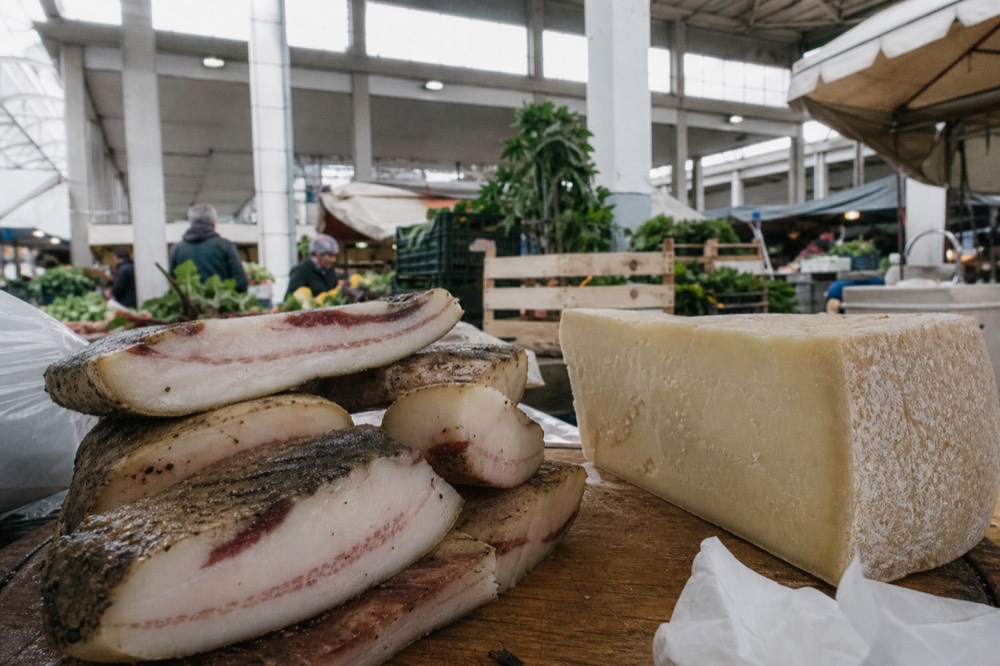
The four ingredients of carbonara are guanciale, Pecorino Romano, egg and black pepper, plus the spaghetti or bucatini itself. Guanciale is cured pork jowl, not bacon or pancetta; the cheese is sheep's-milk pecorino, not Parmesan; the egg is usually yolks, never cream; and the pepper is coarsely cracked, not ground to dust.
That is the whole list. No garlic, no onion, no cream, no herbs. The sauce is not cooked at all in the usual sense: the hot pasta is tossed with the rendered guanciale fat, the cheese and the egg off the heat, so the egg thickens into a creamy coating rather than scrambling. Get the timing and the temperature right and the four ingredients turn into something far bigger than the shopping list suggests.
The proportions matter as much as the items. Most Roman recipes call for roughly 100 grams of pasta per person, a generous handful of guanciale cut into strips, enough pecorino to form a paste with the egg, and two or three yolks depending on how rich you want the result. The pepper goes in twice, once into the melting guanciale fat and once over the finished plate. The dish is a balance of salt, fat, sharpness and heat, and each ingredient carries exactly one of those jobs.
| Ingredient | What it is | Job in the dish | Common substitute to avoid |
|---|---|---|---|
| Guanciale | Cured pork jowl, aged at least 30 days in the traditional process | The fat and the salt, plus the smoky-sweet meat itself | Bacon, pancetta |
| Pecorino Romano | Aged sheep's-milk cheese with PDO status | Sharpness, salt and the emulsifying base of the sauce | Parmigiano-Reggiano |
| Egg | Usually yolks alone, sometimes one whole egg added | Creaminess and binding, thickened off the heat | Cream |
| Black pepper | Coarsely cracked peppercorns | Aromatic heat, the only spice in the dish | Fine pre-ground pepper |
The four ingredients are cheap in Rome and expensive almost everywhere else, which is the honest reason so many imitations exist. Guanciale in particular is hard to find outside Italy, and the US has had its own supply dramas: in September 2026 the USDA announced a recall of roughly 1,513 pounds of imported ready-to-eat Italian guanciale products due to possible Listeria contamination, a reminder that even the authentic ingredient travels through a fragile supply chain. If you want to taste the real thing, tasting it where it is made is simply easier.
Why guanciale and not bacon or pancetta?
Guanciale is cured pork jowl, and it is the only cured meat in the carbonara tradition. It carries a higher fat ratio than pancetta, renders into a softer, sweeter fat than bacon, and its cure is aromatic rather than smoky. Bacon's smoke and pancetta's leaner cut both change the flavor of the finished sauce in ways Romans notice immediately.
The name tells you where it sits on the pig: guancia is the Italian word for cheek. The cut is triangular, taken from the throat area, and in the traditional curing process it is salted and aged for at least a month. The EU has never given guanciale a protected designation of its own, but the specification for Amatriciana Tradizionale, which the EU registered as a Traditional Speciality Guaranteed in March 2020, pins down exactly how the guanciale used in that sauce must be cured and cut. The same cut is the backbone of carbonara, gricia and amatriciana alike.
The specification is unusually blunt about substitutions. It states that the sauce "has always been made with pork jowl, never bacon or pork belly", a line written for Amatrice but quoted constantly in the carbonara debate because the principle is the same. The fat part of the jowl is greater than the lean part, and that ratio is the point. When guanciale renders, the fat stays liquid longer and coats the pasta with a silky film. Bacon fat sets quickly and tastes of smoke, and smoke is a flavor that belongs to other cuisines, not to Roman pasta.
There is a practical note for anyone cooking this at home. Guanciale should be cut into strips about the thickness of a matchstick and started in a cold pan over low heat, so the fat renders out before the meat browns. If the pan is hot from the start the outside crisps and the inside stays raw and chewy. The rendered fat is not waste; it is half the sauce. Many Roman cooks remove the crisp guanciale, cook the pasta, and return the meat only at the very end so it stays crunchy under the egg coating.
Why Pecorino Romano and not Parmesan?
Pecorino Romano is a sheep's-milk cheese with EU PDO protection, and its aggressive salt and sharpness are what cut through the fat of the guanciale. Parmesan is a cow's-milk cheese with a nuttier, sweeter profile, and when it replaces pecorino the sauce goes flat and needs extra salt to compensate. The two cheeses are not interchangeable in this dish.
The protected name is not marketing fluff. Pecorino Romano is registered in the EU's geographical indications register as a PDO, with a specification that dates its protection back to 1996 and its production rules back much further. It is made exclusively from fresh full-fat sheep's milk, produced between October and July, and matured for at least five months for table cheese or eight months for grating cheese. The producer group named on the register is the Consorzio per la tutela del Formaggio Pecorino Romano, and the consortium's own site confirms the Lazio and Sardinia grazing country that supplies the milk.
The 2024/2025 production campaign for Pecorino Romano totalled 39 million kilograms, with 60% exported and the United States taking 131,000 quintals, so the cheese is genuinely available abroad. What matters for carbonara is the flavor chemistry. Sheep's milk carries more short-chain fatty acids than cow's milk, which is why aged pecorino reads as sharp, salty and slightly piccante rather than sweet. Against a fat-heavy sauce, that sharpness is not optional. It is the only acidic counterweight the dish has.
Some Roman recipes do blend the two cheeses, a spoonful of Parmesan into the pecorino to soften the edge. That is a real local variation and worth trying once you have made the strict version. What no Roman recipe does is use Parmesan alone, because without the sheep's-milk bite the sauce tastes like a generic creamy pasta rather than a Roman one. If your pecorino is very aged and very salty, taste before adding extra salt to the pasta water, since the cheese will bring plenty.
Eggs: whole eggs, yolks, or cream?
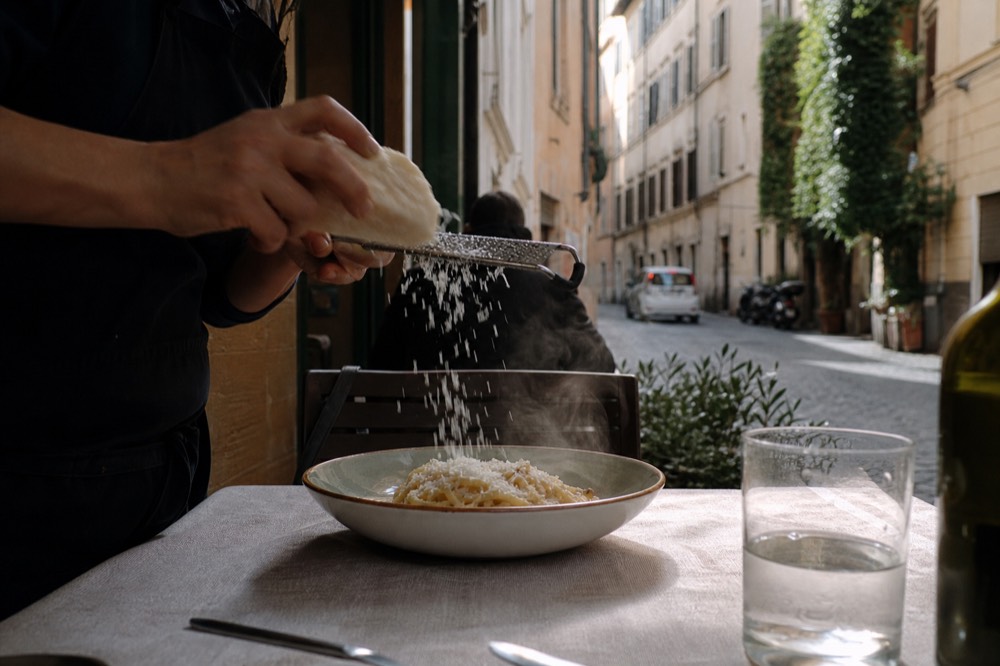
The egg in carbonara is usually yolks alone, at roughly two to three per portion of pasta for two people, sometimes with one whole egg added for looseness. Cream is never used in the Roman version. The yolks provide the creaminess, and they must be combined with the cheese and cooked only by the residual heat of the pasta, off the flame, or they scramble.
The yolk-versus-whole-egg question is the one place where Roman kitchens genuinely disagree. Strict versions use only yolks, which give a richer, denser, more golden sauce. Others add one whole egg to a batch of yolks, because the white thins the sauce slightly and makes the tossing easier, especially in a restaurant setting where the pasta sits for a minute before service. Neither camp uses cream, and the cream question is the one that gets Roman cooks genuinely irritated.
The reason cream exists in so many international versions is fear. Raw egg plus hot pasta feels risky if you have never done it, and cream looks like insurance against scrambling. In practice the technique is the insurance. The pasta should be drained a touch early, tossed hard with the cheese-and-egg mixture off the heat, and finished with a splash of starchy pasta water until the sauce coats each strand. Residual heat is enough to thicken the yolk into a custard-like emulsion. Direct heat turns it into sweet scrambled eggs in seconds.
A note on safety and freshness: use the freshest eggs you can find and keep them cold until the moment of use. The emulsion works because the yolk proteins and the cheese proteins bind the rendered fat, and starchy water helps keep everything suspended. If the sauce ever looks grainy or broken, more pasta water and more vigorous tossing usually bring it back. It is a technique dish, which is exactly why so many travellers book a class instead of guessing from a recipe video.
Black pepper: the ingredient everyone forgets
Black pepper is the fourth ingredient and the one most often treated as an afterthought. In carbonara it is not a garnish but a structural flavor, the only spice in the dish, coarsely cracked and added twice: once into the rendering guanciale fat and once cracked over the plated pasta. Fine pre-ground pepper dissolves into nothing and the sauce loses its aromatic edge.
The pepper is also hiding in the dish's most likely origin story, the one that connects carbonara to the older Roman pasta called gricia. Gricia is guanciale and pecorino, no egg, and some food historians read carbonara as gricia plus egg, with the black specks of pepper standing in for the visual role that the pepper of cacio e pepe plays in that other Roman classic. The histories are contested and no official source settles them, but the family relationship between the four Roman pastas is not contested at all: carbonara, cacio e pepe, gricia and amatriciana are the quartet, and they share guanciale and pecorino as common parents.
Technique matters here more than quantity. Cracking the peppercorns coarsely, in a mortar or with the flat of a knife, releases the aromatics into the hot fat where they bloom the way garlic does in other cuisines. The second application at the table is fresh and fragrant, giving the dish its characteristic black flecks. This is the same logic that governs cacio e pepe, where the pepper is toasted in a dry pan before the cheese goes anywhere near it. If you want a deeper look at that sibling dish, our guide to Rome's classic pasta dishes covers the full quartet and where to eat each one.
The quantity is up to you, within reason. Roman carbonara is visibly peppery, more so than most international versions, and the heat should register on the first bite without dominating. A teaspoon of cracked pepper for a two-person portion is a sane starting point. Grind it fresh, taste as you go, and remember that the pepper is doing the aromatic work that garlic and chilli do in other Roman sauces like amatriciana, which the EU specification allows to carry fresh or dried chilli alongside its guanciale.
The substitutions, ranked by how badly they go wrong
The four commonest substitutions are bacon for guanciale, Parmesan for pecorino, cream for egg, and garlic added on top of everything. The first two mute the dish, the third changes it into a different sauce entirely, and the fourth is simply not part of the recipe. None of them is a crime, but each one moves the plate further from what a Roman trattoria serves.
| Substitute | What it changes | How far from the original |
|---|---|---|
| Bacon for guanciale | Adds smoke, loses the sweet soft fat | Noticeable in every bite |
| Pancetta for guanciale | Leaner, less fat to render, milder cure | Close, but the sauce is thinner |
| Parmesan for pecorino | Sweeter, less sharp, needs extra salt | The dish goes flat |
| Cream for egg | Silky but heavy, no custard note, cold on the plate | A different dish entirely |
| Garlic or onion | Aromatics that mask the guanciale cure | Not in the recipe at all |
| Fine ground pepper | No aroma bloom, no visible flecks | Small but real loss |
Bacon is the most forgivable of these because it is the most available, and in a country where guanciale is hard to buy, a thick-cut unsmoked bacon is the least-damaging stand-in. Smoked bacon is the bigger problem, because smoke is a loud flavor and it fights both the pecorino and the egg. Cream is the least forgivable, because it does not just substitute an ingredient, it replaces the technique. The whole point of carbonara is that a raw egg, cheese and rendered fat become a sauce through heat management and tossing, and cream removes the one skill the dish asks of you.
Garlic deserves a specific word because it is the substitution people defend hardest. Garlic is everywhere in Roman cooking, in the vegetable dishes, the braises, the bruschetta. It is simply not in the four pastas. The aromatic role in carbonara belongs to pepper, and adding garlic turns the guanciale into a supporting player in someone else's dish. If you love garlic, order the puntarelle alongside and you will get plenty.
Is there an official carbonara recipe?
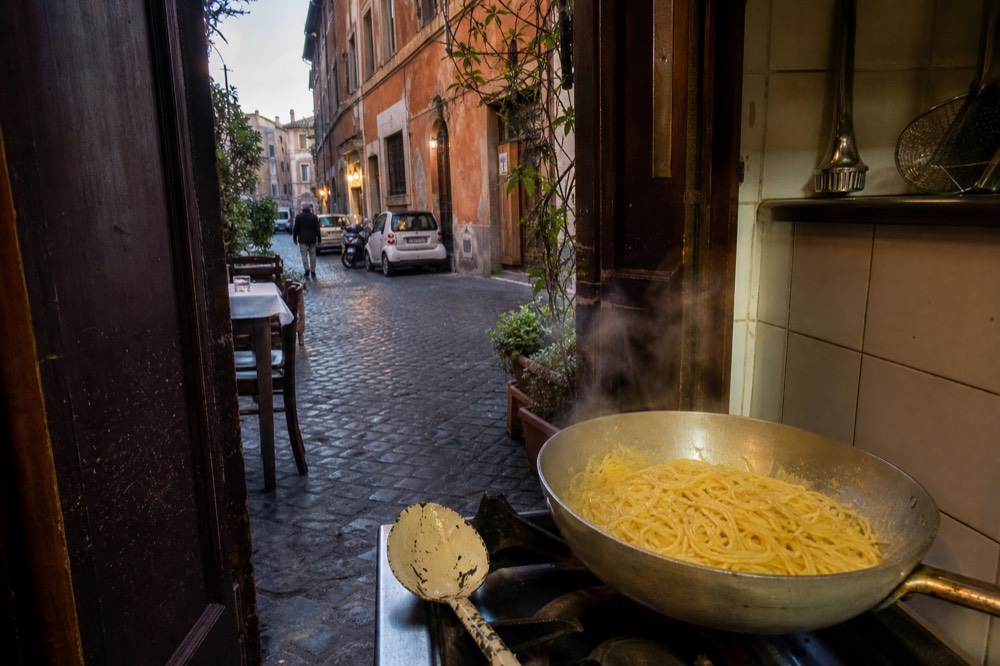
No. Carbonara has no PDO, PGI or Traditional Speciality Guaranteed status, unlike amatriciana, which the EU registered as a TSG in 2020 with a legally defined sauce composition. The four Roman pastas differ sharply here: cacio e pepe, gricia and carbonara have no PDO or PGI on the EU register, so the recipe lives in tradition and argument rather than in law.
That legal gap is why the argument never ends. The Amatriciana Tradizionale specification spells out that the sauce must be 18 to 30 percent Amatrice pork jowl and 69 to 81 percent tomato, with the guanciale cured at least 30 days, and it even records the history: people from Amatrice moved to Rome through the 19th century and worked in catering, carrying the sauce with them. Carbonara has no equivalent document. Its history is genuinely murky, with origin stories involving Allied troops and egg rations after the Second World War, and none of them is documented well enough to settle anything.
What carbonara does have is an enormous cultural consensus. The Carbonara Day campaign, run by Unione Italiana Food and IPO, marked its tenth edition in April 2026 with the AstraRicerche survey that found 46.1% of Italians calling carbonara their favorite pasta, and the campaign reported a ten-year social reach of 1.7 billion people with roughly two million Instagram posts under the hashtag. Delivery data from the same period recorded over 250,000 carbonara orders across Italy in a year, with Rome leading every other city. Crowd rankings agree too: in the TasteAtlas ranking of best spaghetti dishes published in November 2025, carbonara placed first worldwide.
That consensus is why the substitutions provoke such heat. When millions of people agree on a four-ingredient definition, a cream version is not just a variation, it reads as a rejection of the shared thing. You can read the full anatomy of what goes wrong in practice in our piece on common carbonara mistakes, from scrambled eggs to watery sauce.
Learn the sauce where it lives
Reading about carbonara and making it are two different experiences, and the gap is technique, not knowledge. Nobody scrambles the egg because they do not know the recipe; they scramble it because the pan was too hot or the tossing too timid. A hands-on class shortens that learning curve dramatically, because an instructor watches your pan, not your shopping list.
The Fresh Pasta-Making Class with Wine and Gelato in Rome runs 3 hours, costs $63.87 per person, and is rated 4.9 from 928 reviews. You make the pasta itself from flour and egg, which teaches you the dough feel that no video conveys, and the Roman sauces come with it. It pairs naturally with a wider plan: our guide to pasta making classes in Rome compares the main options by price, length and neighbourhood. You can also Check availability on the operator's live listing.
For a deeper dive, the Home Cooking class in Testaccio teaches three Roman pastas, cacio e pepe, amatriciana and carbonara, in a home-kitchen setting in the neighbourhood where the slaughterhouse workers invented the quinto quarto tradition. It costs $93.47 per group, price varies by group size, runs 3 hours, and is rated 4.9 from 106 reviews. Three sauces in one afternoon is the fastest way to feel the difference between them in your hands.
If your trip is short and you would rather eat than cook, the VIP Golf Cart Food Tour by Eating Europe covers pasta and gelato across the center in 4 hours, from $191.67 per group, rated 4.9 from 268 reviews. It is a tasting itinerary rather than a lesson, but it puts the four pastas in front of you in the places that make them daily.
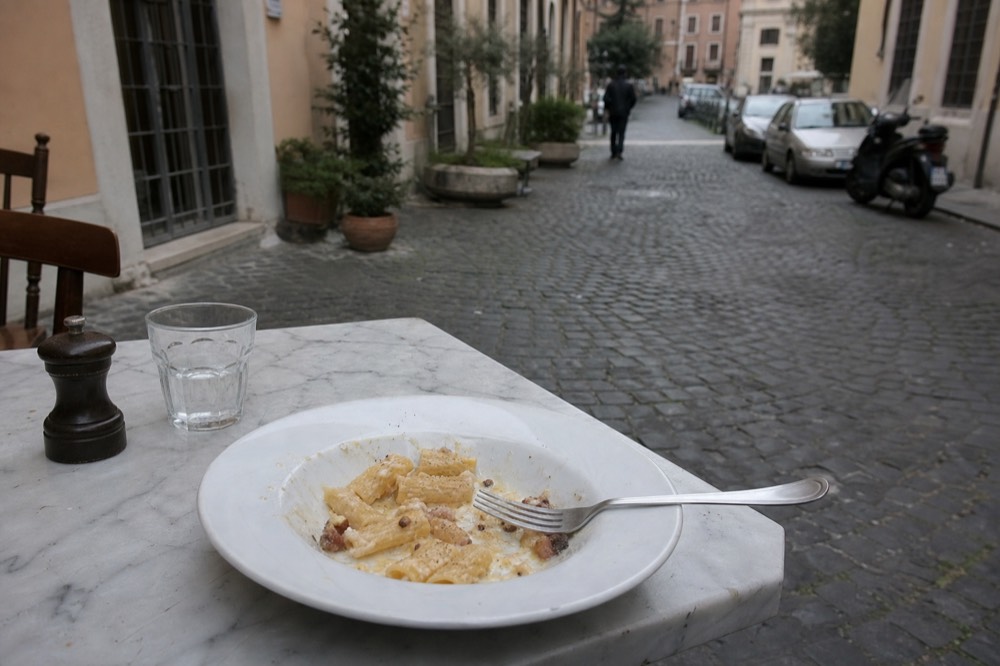
The four ingredients are guanciale, Pecorino Romano, egg and black pepper, and the questions below cover the substitutions people ask about most: pancetta, cream, the cheese's protected status, the lack of an official EU recipe, and how much pepper to use. Each answer states the Roman position plainly, with the reasoning behind it.
Common questions about carbonara ingredients
what are the 4 ingredients in carbonara?
Guanciale, Pecorino Romano, egg and black pepper, plus the pasta itself, usually spaghetti or bucatini. Guanciale is cured pork jowl, the cheese is aged sheep's-milk pecorino, the egg is most often yolks, and the pepper is coarsely cracked. No cream, no garlic, no onion appears in the Roman version.
Can I use pancetta instead of guanciale?
You can, and it is the closest of the common substitutes, but it is not the same. Pancetta comes from the pork belly, is leaner, and renders less of the soft sweet fat that makes the carbonara coating silky. The dish will be respectable, just recognisably less rich.
Why is cream never used in carbonara?
Because the creaminess is supposed to come from raw egg yolk emulsified with cheese and rendered guanciale fat, thickened only by the residual heat of the drained pasta. Cream replaces that technique with a shortcut and produces a heavier, colder sauce. Roman kitchens treat it as a different dish altogether.
Is Pecorino Romano protected?
Yes. It is a PDO registered in the EU's geographical indications register, made exclusively from sheep's milk in Sardinia, Lazio and the province of Grosseto, matured at least five months for table cheese and eight for grating. Parmesan is also a protected cheese, but it is a different cheese, and in carbonara it is a substitution.
Does carbonara have an official EU recipe like amatriciana?
No. Amatriciana Tradizionale is a registered Traditional Speciality Guaranteed with a legally defined sauce composition, but carbonara, cacio e pepe and gricia have no PDO or PGI. The four-ingredient definition comes from tradition and broad consensus, not from a regulation.
How much black pepper goes in carbonara?
Roughly a teaspoon of coarsely cracked pepper for a two-person portion, added twice: once into the hot rendered guanciale fat so the aromatics bloom, and once cracked fresh over the plated pasta. The dish should be visibly peppery, with the heat registering on the first bite.