what is rome's signature dish?
Rome's signature dish is really a family of four pastas: carbonara, cacio e pepe, gricia and amatriciana. Here is why the city answers with a canon rather than one plate.
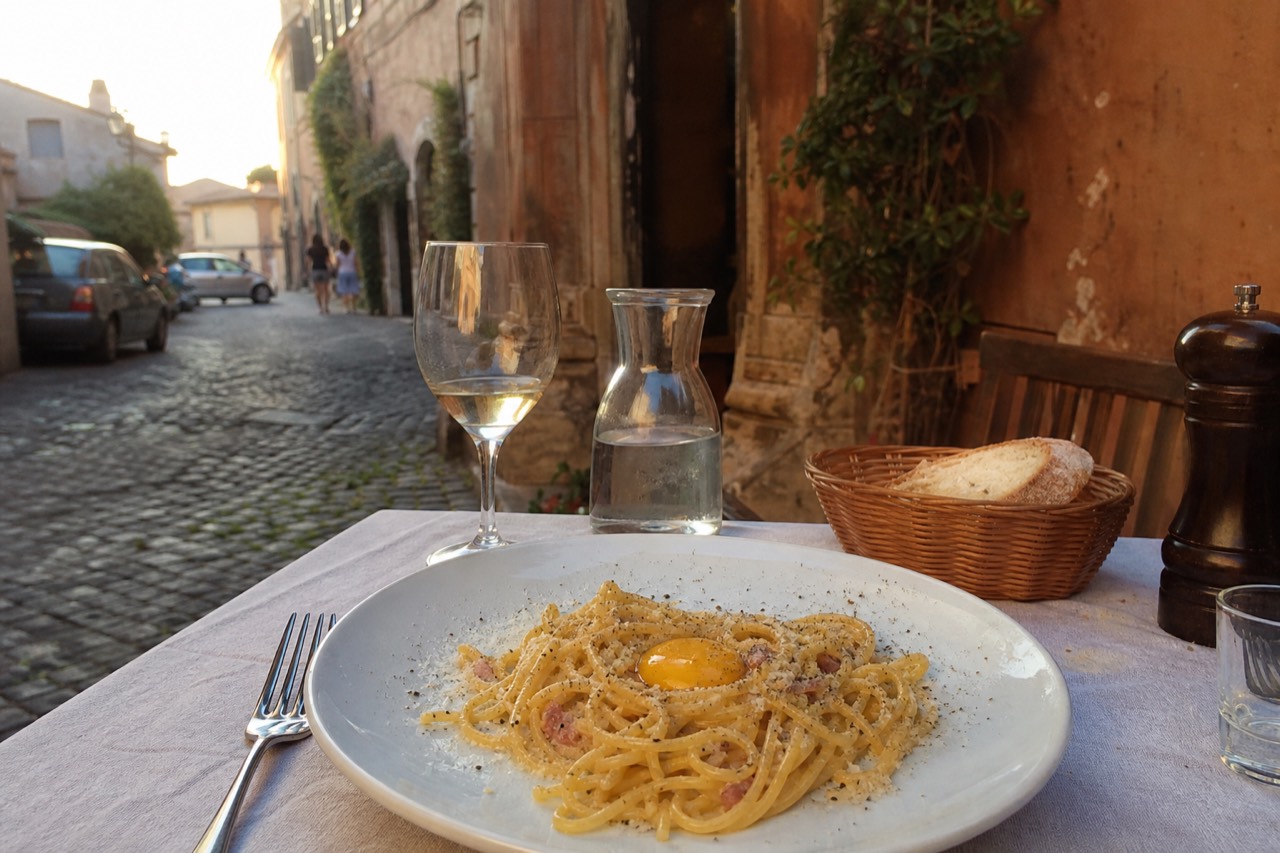
Ask ten Romans to name their city's signature dish and you will collect the same four names, in roughly the same order, every time. Carbonara comes first by sheer popularity: an AstraRicerche survey of 1,004 Italians ahead of Carbonara Day 2026 found 46.1% naming it their favorite pasta dish. But carbonara never travels alone in this conversation. It belongs to a canon of four pastas, carbonara, cacio e pepe, gricia and amatriciana, that together define what Roman cooking is.
what is rome's signature dish?
Rome's signature dish is not one plate but a family of four pastas: carbonara, cacio e pepe, gricia and amatriciana. All four are built on the same short list of ingredients, Pecorino Romano, guanciale and black pepper, and three of the four carry no protected designation at all, while amatriciana holds the region's only EU-registered sauce. If one plate must be picked, carbonara is the favorite, with 46.1% of Italians naming it their top pasta in 2026.
The reason Rome answers with a family rather than a single dish comes down to how the four relate to each other. Strip the egg out of a carbonara and you have gricia. Strip the tomato out of an amatriciana and, again, you have gricia. Cacio e pepe is the same sauce idea with no meat at all, just pecorino and pepper worked into starchy pasta water until it turns silky. A cook who can make one can, in principle, make all four, and a trattoria menu that lists them is really listing one technique with four variations.
That shared skeleton is why the four get discussed as a canon. The ingredients that link them are real, protected products. Pecorino Romano is a PDO registered with the EU since 1996, made exclusively from sheep's milk in Lazio, Sardinia and the province of Grosseto, and matured at least five months for table cheese, eight for grating. The cured pork jowl, guanciale, has no protected designation of its own; what pins it down is the Amatriciana Tradizionale TSG specification, which requires it cured at least 30 days and cut from the throat in a triangle with more fat than lean.
The canon also has a paper trail that most city cuisines lack. Amatriciana Tradizionale was registered as a Traditional Speciality Guaranteed by Commission Implementing Regulation (EU) 2020/395, and the published specification states plainly that the sauce "has always been made with pork jowl, never bacon or pork belly". The same document records the historical route: tomato was added to the rural recipe in the early 19th century, and through that century people from Amatrice moved to Rome and worked in catering, carrying the sauce with them. That is the documented path by which a mountain town's sauce became a Roman signature.
Here is the canon at a glance, with the differences that matter when you are standing in front of a menu.
| Dish | Core ingredients | What makes it distinct | Protected status |
|---|---|---|---|
| Carbonara | Pecorino, guanciale, egg, pepper | The egg, worked in off the heat | None |
| Cacio e pepe | Pecorino, pepper | No meat; the emulsion is everything | None |
| Gricia | Pecorino, guanciale, pepper | Carbonara minus the egg | None |
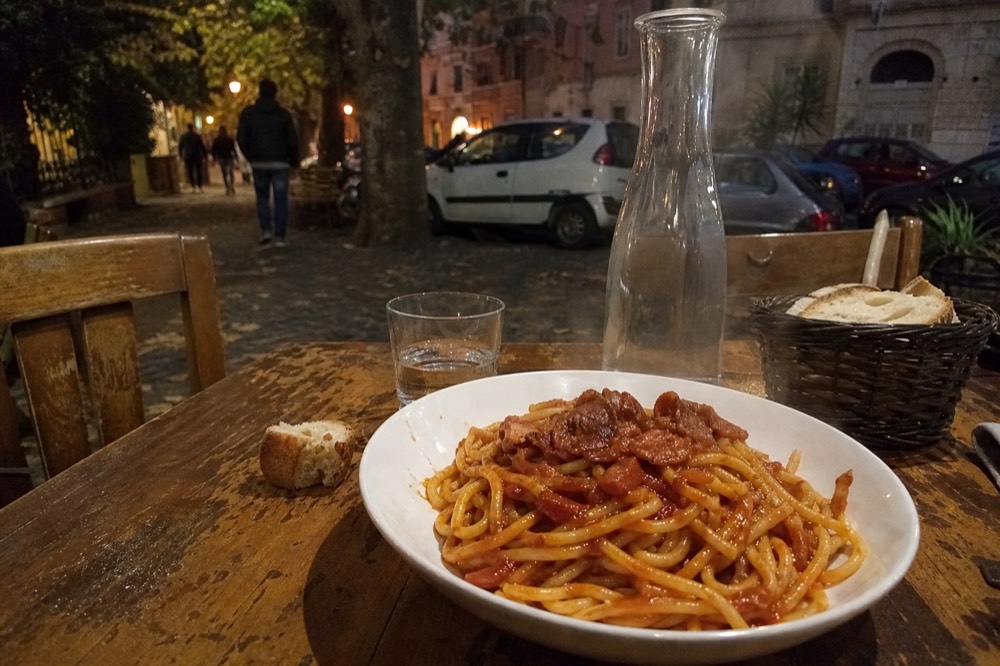
| Amatriciana | Pecorino, guanciale, tomato, pepper | The tomato | TSG, registered 2020 |
If you want to taste the whole canon in one evening rather than assembling it from restaurant visits, a guided class or tour is the efficient route. These three options cover the range, from a family-friendly class that teaches the basics to a golf-cart tour that pairs the pastas with sightseeing.
For a deeper look at the ingredient list behind the most famous member of the family, see the four ingredients in carbonara, which breaks down guanciale, egg, pecorino and pepper one by one.
Why carbonara is the crowd favorite
Carbonara is the dish with the numbers behind it. It has topped Italian preference surveys for years, it placed first in TasteAtlas's November 2025 ranking of the world's best spaghetti dishes, and its ten-year Carbonara Day campaign reached a reported 1.7 billion people on social media. Yet it has no PDO, no PGI and no confirmed EU registration of any kind; its protection is purely cultural, which is a rare thing for a dish this famous.
The survey numbers are worth pausing on. The AstraRicerche poll, run for the tenth Carbonara Day on 6 April 2026 by Unione Italiana Food and IPO, asked 1,004 Italians to name their favorite pasta. Carbonara took 46.1%. Delivery data tells the same story from another angle: in the twelve months before April 2026, one delivery platform recorded over 250,000 carbonara orders in Italy, with Rome logging the highest volume of any city. Whether Romans order it most or defend it most passionately is debatable; that they order it a great deal is not.
TasteAtlas, a crowd-rated food aggregator rather than an institutional judge, put Roman carbonara first among spaghetti dishes worldwide in its November 2025 ranking. Its 2026 pasta ranking told a different story, with carbonara tenth behind Piedmont's tajarin al tartufo bianco d'Alba, which is a useful reminder that crowd ratings move. Roman opinion, for what it is worth, has been remarkably stable.
The recipe itself is the most contested of the four. Eggs or no egg whites, guanciale versus the pancetta that appears in imitations abroad, cream which no Roman admits to, and the exact moment the egg meets the hot pasta. The common mistakes are common enough to fill their own article, and the canon's other members cause far less argument. What nobody disputes is the dish's status as the face of Roman pasta abroad.
The scale of that fame is measurable in export terms too. Italian pasta exports totalled 2,456,940 tonnes worth 3.969 billion euros in 2025, up 2.1% on the year before, and while that figure covers every shape and sauce, the carbonara name is the one that sells the idea of Roman eating to the world. A dish with no legal protection and a ten-year social reach of 1.7 billion people is protected by something stronger than a register: repetition.
Cacio e pepe: the minimalist of the four
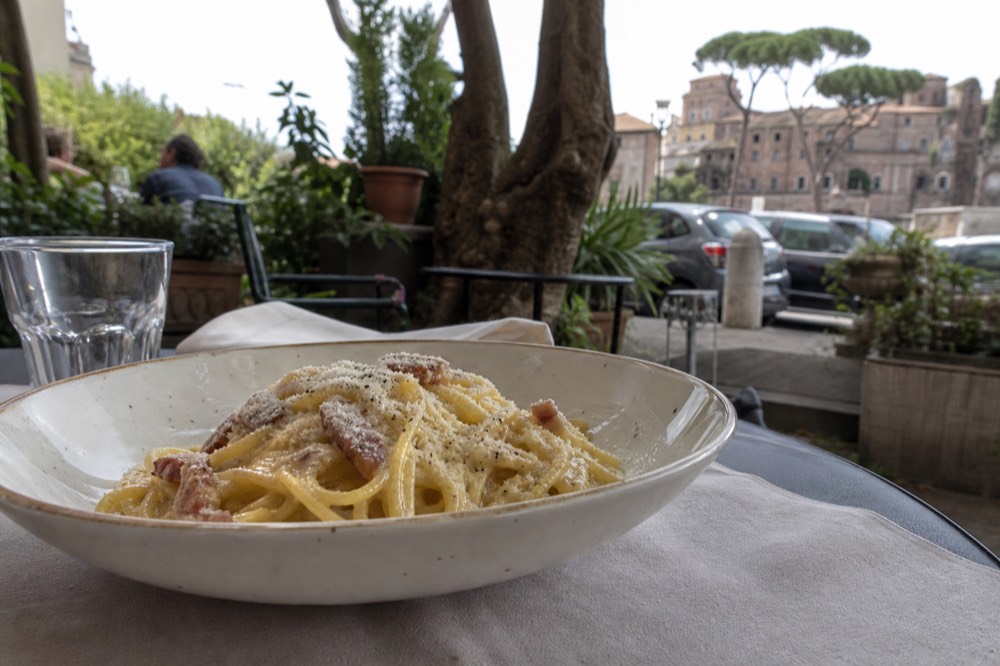
Cacio e pepe is the canon's purest expression: pasta, Pecorino Romano and black pepper, nothing else. Its entire technique lives in emulsifying the cheese with hot pasta water so the sauce coats each strand without clumping, and it is the dish Roman cooks use to judge other Roman cooks. Like carbonara it has no PDO or PGI; the only protected ingredient in the bowl is the pecorino itself.
It looks like the easiest of the four and is in practice the hardest. Pecorino Romano, a hard, salty, aged sheep's milk cheese, wants to seize into a clump the moment it meets heat that is too high or water that is too little. The trick is temperature control and a splash of the starchy water the pasta was cooked in, worked fast. When it goes right the sauce is glossy and loose; when it goes wrong you get stringy cheese and a dry bowl.
The cheese deserves the credit. Pecorino Romano PDO has been registered with the EU since 1996, with a specification that fixes everything from the sheep's milk source to the diamond-shaped brand stamped on each wheel's heel. Production runs October to July, and the 2024/2025 campaign for Pecorino Romano DOP totalled 39 million kg, with 60% exported and the United States the largest single market. A cheese that travels that far and that heavily is inevitably the backbone of the city's most exported pasta ideas.
Pepper is the other half of the name and the older half of the dish. Long before tomato arrived in Roman kitchens, pepper and cheese were the seasoning pair for pasta, and cacio e pepe is essentially that pre-tomato formula preserved. It is the dish most likely to appear on a trattoria menu as a primo with no garnish, no variation and no apology, and the one most likely to be ordered by locals who want to see whether the kitchen can actually cook.
Gricia, the missing link
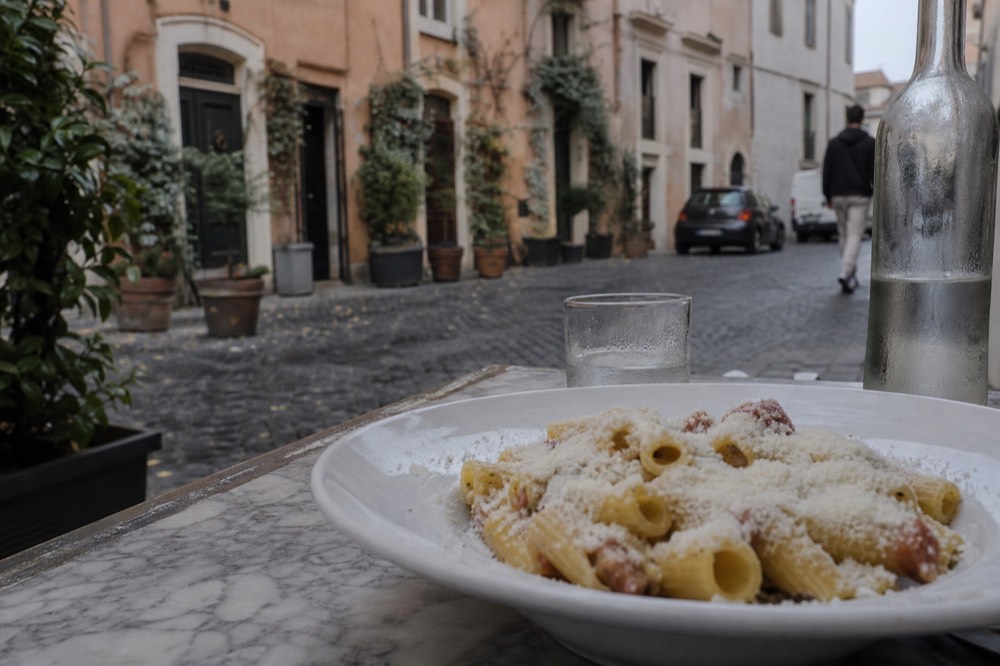
Gricia is the least known of the four outside Rome and the most instructive: pasta with guanciale and pecorino, no egg, no tomato. It is literally carbonara minus the egg and amatriciana minus the tomato, which is why food historians treat it as the parent of both. It has no protected status, and its guanciale is defined only indirectly, through the TSG specification that governs its daughter dish, amatriciana.
Order gricia in Rome and you are eating the family tree in one plate. The guanciale is cut into strips or small pieces and rendered slowly until the fat turns glassy and the meat crisps at the edges, then the pasta, typically rigatoni or spaghetti, is finished in that fat with pecorino beaten in off the heat. The result is richer than cacio e pepe, sharper than carbonara, and it is the dish Romans are most likely to tell you foreigners have never heard of.
The guanciale itself is worth understanding because it is the ingredient that separates Roman pasta from Italian pasta generally. Cured pork jowl, triangular, more fat than lean, cured at least 30 days in the version the TSG specification describes for amatriciana, it renders differently than pancetta and carries more sweetness. It has no PDO or PGI of its own, a fact confirmed by a search of the EU's full geographical indications register, which returns zero entries for it. The specification of Amatriciana Tradizionale TSG is the only official document that pins down how it must be cured and used.
Guanciale has had its moments of legal drama abroad, which only underlines how central it is to the canon. Import rules in the United States have long complicated the supply of authentic cured jowl, and the topic has its own history on this site. If you want that story, why guanciale was banned in the US covers it in full, from the import restrictions to what American cooks substitute.
Amatriciana, the only one with an EU registration
Amatriciana is the only member of the canon with a confirmed EU registration: Amatriciana Tradizionale TSG, registered in March 2020. Its specification fixes the sauce at 18 to 30% guanciale and 69 to 81% tomato, with grated Amatrice pecorino or Lazio Pecorino Romano PDO, and states that the sauce has always been made with pork jowl, never bacon. The first International Amatriciana Day was held on 6 March 2026, marking the date of its STG recognition.
The registration matters more than it might sound. Of the four pastas, carbonara, cacio e pepe and gricia have no PDO or PGI; the verified position is that their names are protected culturally, not legally. Amatriciana is different: the TSG specification is enforceable copy for what the sauce must contain, and it settles the pancetta argument in print. The historical account in the same document, tomato arriving in the early 19th century and Amatrice emigrants bringing the sauce to Roman trattorias, is the only officially recorded origin story in the whole canon.
The dish's home town has been building on that recognition. The first International Amatriciana Day was held in Amatrice on 6 March 2026, organised by the local producers' association with events across the weekend, timed to the anniversary of the STG recognition. For a small mountain town, a registered sauce with an international day is both heritage and economy.
In Rome the dish is usually bucatini, the thick-walled hollow spaghetti, though the specification allows short pasta too. It is the most substantial of the four, the one that pairs with a full red from the nearby hills, and the one most likely to appear on a Sunday table rather than a quick weeknight one. Lazio's wine industry has been scaling up alongside it: the 2025 harvest in Lazio produced 764,000 hectolitres, up 5% on 2024, and a new consortium for Cesanese di Olevano Romano DOP was recognised by ministerial decree in September 2025.
The specification's composition rules are precise enough to be worth seeing side by side, because they show what a legally defined Roman sauce looks like.
| Amatriciana TSG component | Share of the sauce |
|---|---|
| Amatrice pork jowl (guanciale) | 18 to 30% |
| Tomato passata and/or peeled chopped tomato | 69 to 81% |
| Extra virgin olive oil | 0.5 to 1% |
| White wine, salt, chilli or pepper | To taste |
Why Rome answers with four pastas, not one
The four-pasta canon exists because the dishes are one technique with four variations, because their shared ingredients, pecorino and guanciale, are the actual products of the region, and because Roman identity runs through the trattoria menu rather than a single emblem plate. UNESCO's inscription of Italian cuisine as intangible heritage in December 2025 recognised the tradition as a whole, not any one dish, and Rome's own contribution is best understood the same way.
The UNESCO decision is the biggest external validation the canon has received. On 10 December 2025, at the 20th session in New Delhi, the Intergovernmental Committee inscribed "Italian cooking, between sustainability and biocultural diversity" on the Representative List of the Intangible Cultural Heritage of Humanity, the first time an entire national cuisine received the designation. The Italian government immediately framed it as a tool for protecting products from imitation, with industry estimates projecting up to 8% tourism growth and 18 million additional overnight stays within two years.
Rome's part in that national story is the four pastas plus the supporting cast: carciofi alla romana and the Jewish quarter's carciofi alla giudia in artichoke season, which the Carciofo Romanesco del Lazio PGI specification dates from January into May, and the quinto quarto offal tradition of the Testaccio slaughterhouse district. But the pastas are the daily answer, the ones on every menu from a workmen's trattoria to a fine dining room.
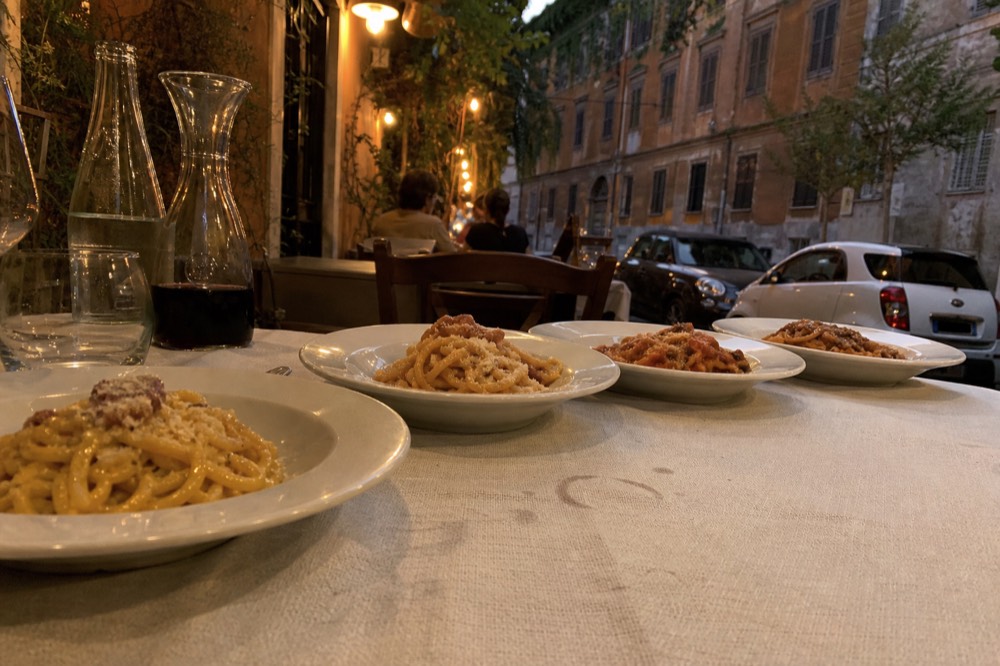
The practical upshot for a visitor is simple: do not hunt for one signature plate, order across the canon. One restaurant, one long lunch, and you can taste all four and understand the family resemblance immediately. The full must-eat list for the city, including the artichokes and the offal dishes that sit alongside the pastas, is covered in Rome's must-eat dishes.
Learning to make them is the other half of the experience, and it is where a class earns its place. The Family-Friendly Pasta & Tiramisu class from Carpe Diem Tours runs three hours at $60.39 per person and holds a 4.9 rating from 263 reviews, a solid entry point for cooks of any age. It is the kind of session where the canon stops being a menu and becomes something you can reproduce at home.
For a more technique-focused alternative, the Fresh Pasta-Making Class with Wine and Gelato from Walks of Italy, three hours at $63.87 per person with a 4.9 rating from 928 reviews, digs into dough work and finishes with gelato. Between them they cover both ways into the canon: family fun and hands-on skill. There is also a wider comparison of formats and prices in cooking classes in Rome, and a pasta-specific rundown in pasta making classes in Rome if dough work is the part that appeals.
If walking and tasting suits your travel style better than cooking, the VIP Golf Cart Food Tour from Eating Europe covers the city's classic plates with pasta and gelato stops along the way, four hours at $191.67 per group with a 4.9 rating from 268 reviews. It is the most comfortable format for covering ground between neighbourhoods, and it pairs the canon with the sights around it.
Whichever route fits, these three are the strongest picks for putting the four pastas in front of you in a single visit.
Rome's signature dish question has a short answer and a long one. The short answer is carbonara, the crowd favorite at 46.1% in the 2026 national survey. The long answer is the four-pasta canon, carbonara, cacio e pepe, gricia and amatriciana, one technique with four variations, all built on Pecorino Romano and cured pork jowl, with amatriciana alone carrying an EU registration. These are the questions visitors ask most.
Common questions about rome's signature dish
what is rome's signature dish?
Rome's signature dish is a family of four pastas: carbonara, cacio e pepe, gricia and amatriciana. All four share Pecorino Romano and, in three cases, guanciale. If one plate must be singled out, carbonara is the public favorite, named by 46.1% of Italians as their top pasta in a 2026 survey.
What food dish is Rome famous for?
Rome is famous for its four-pasta canon, carbonara, cacio e pepe, gricia and amatriciana, plus carciofi alla romana, carciofi alla giudia and the quinto quarto offal dishes of Testaccio. The pastas are the daily signature; the artichokes are the seasonal one.
Which of the four Roman pastas is the oldest?
Cacio e pepe is generally treated as the oldest formula, since pepper and cheese seasoned pasta long before tomato reached Roman kitchens. Gricia is the direct parent of both carbonara and amatriciana. The only officially documented history is amatriciana's: its TSG specification records tomato being added in the early 19th century and the sauce arriving in Rome with Amatrice emigrants.
Does carbonara have protected status like other Italian foods?
No. Carbonara, cacio e pepe and gricia have no PDO or PGI. The only EU-registered member of the canon is Amatriciana Tradizionale TSG, registered in March 2020. The protected ingredients in the bowl, such as Pecorino Romano PDO, are what carry the legal weight.
Is bacon ever used in an authentic Roman pasta?
No. The Amatriciana Tradizionale TSG specification states that the sauce has always been made with pork jowl, guanciale, never bacon or pancetta. The same cut is what defines gricia and, by tradition, carbonara. Substitutions happen abroad, but they are not the Roman recipe.
Can I learn to make the four pastas in Rome?
Yes. Cooking classes in Rome routinely cover the canon, from the $60.39 family-friendly pasta and tiramisu session to more technique-driven fresh pasta classes at $63.87 per person. Three hours is the typical length, and most include wine.
Whichever plate you decide is your personal signature, the honest answer is the one this site keeps returning to: Rome cooking is a technique, and the four pastas are its four sentences. Learn one and you have learned the grammar. For where to start, Rome Food Tours keeps the full roster of walks, classes and tastings that put the canon on the table in front of you.